
From the Heart of Jerusalem to the People of Iran: A Sassanid Treasure in the Soil of the Temple Mount
Dedicated to the memory of Dr. Gabriel Barkay (1944–2026) z”l, and the brave citizens of Iran.
The early 7th century in Jerusalem was a time of seismic shifts. For nearly 300 years, the city had been an important jewel in the crown of the Christian Byzantine Empire, but in 614 CE, the “Last Great War of Antiquity” brought the Sassanid Persians to the gates. Jewish soldiers provided critical intelligence and logistical support to the Persians who were unfamiliar with the rugged topography of Judea and the urban layout of Byzantine Jerusalem. Following a brutal 21-day siege, the city fell to the forces of Khosrow II and his general, Shahrbaraz, marking a rare 14-year window of Persian rule that would fundamentally alter the city’s destiny before the Byzantine recapture in 628 CE. This brief but intense “Sassanian interlude” saw the city shift from a closed Byzantine center to a place of potential national revival for the local Jewish population.
While we often speak of the “Persian Period” in Jerusalem in the context of the mid-6th to mid-4th centuries BCE, from the return from the Babylonian exile under Cyrus, and the reconstruction of the city under Ezra and Nehemiah until the toppling of the Persian Achaemenid empire by Alexander the Great, it is exceptionally rare to find artifacts from Jerusalem’s “Second Persian Period,” the brief 14-year window of Sassanid rule between 614 and 628 CE. A few dramatic discoveries from this period include the Ophel menorah medallion, likely intended as an ornament for a Torah scroll, and the “House of Menorot”, where a Christian cross was plastered over to reclaim the space. We also have the tragic evidence of the conquest’s violence found in the Byzantine mass graves at Mamilla, a somber reminder of the 614 CE siege.
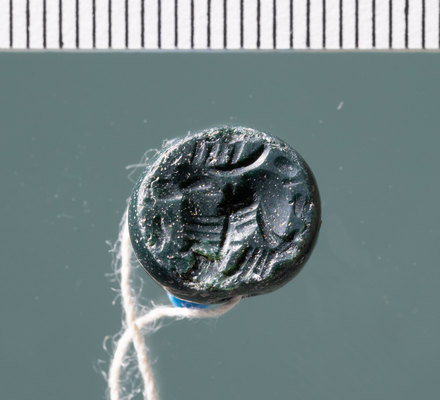
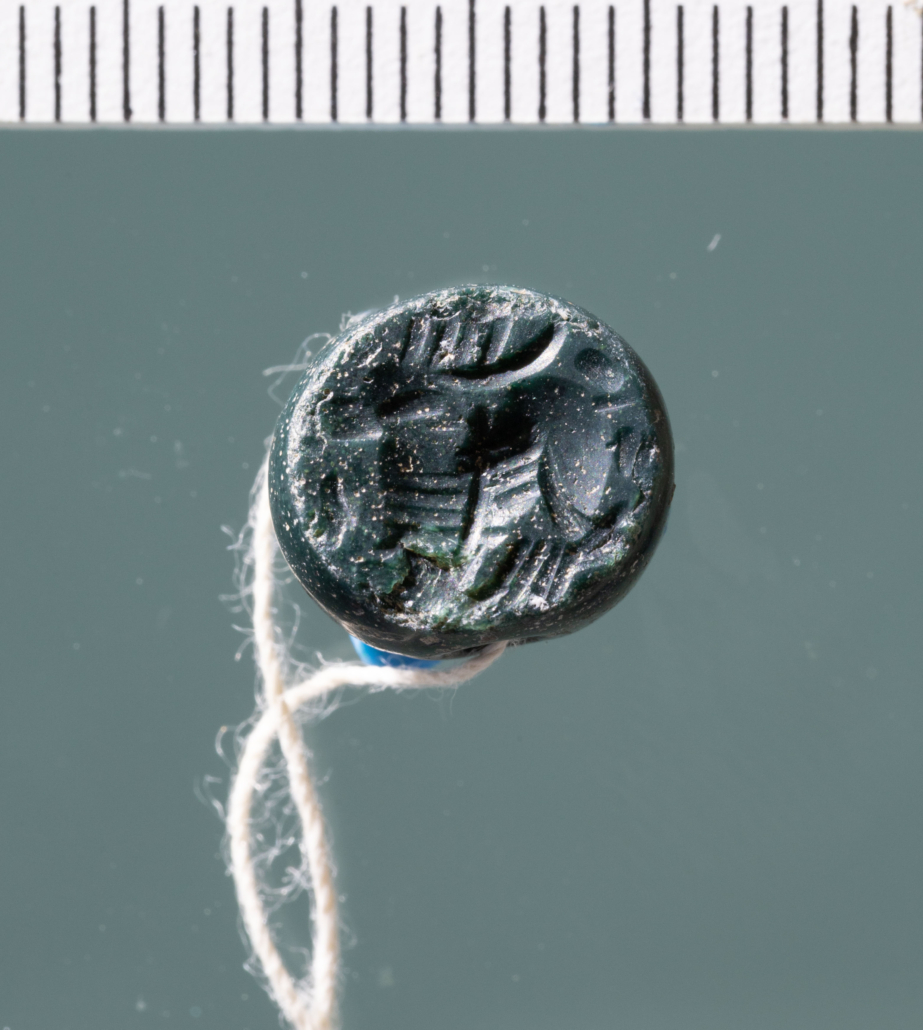
In the quiet hum of the Temple Mount Sifting Project lab, an artifact’s true identity often rests on a single, sharp-eyed observation. Such was the case with a small, dark object that had been initially set aside as a “broken bead.” Our glass expert, Dorit Gutreich, was sorting through the beads when she paused over this particular piece. “I realized it wasn’t broken but carved,” Dorit recounts. “I hesitantly asked other people at the lab if it’s true or am I imagining things; then I started looking online for similar stone seals, and learned it is from the Sassanian period.”
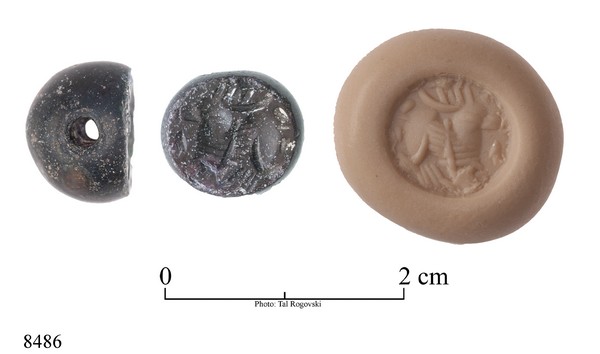
Upon close examination, the technical sophistication of the piece is evident, marking it as a product of a high-level imperial workshop. Expert analysis by geologist Dov Levitte has identified the material as a type of chalcedony, either green Jasper or heliotrope. The stone’s color is dark green with two light-brown spots and takes the form of an intact, low dome (hemispheroid) perforated near its flat, oval base. The technical execution of the piece is highly characteristic of ancient glyptics; the animal’s torso is defined by deep, rhythmic “hatched” incisions created with a combination of wide-round drills and thin drills. This hatched ribbing is a clear diagnostic feature of Sassanid gem-cutting traditions.
The specific identity of the animal, however, has sparked a fascinating debate. Shua Amorai-Stark identified the motif as a zebu bull (the back-humped bull), a reclining bovine facing left. Beyond the general silhouette, she points to the specific “back-humped” posture and the use of wide round drills to emphasize the heavy chest and shoulders, which are diagnostic hallmarks for bovines in Sassanian glyptic art. The zebu was a sacred animal representing the Zoroastrian deity Vohu Manah and the “primeval bull,” serving as a symbol of divine protection and cosmic order. This religious significance made it a prominent motif on royal seals and luxury silverwork, where it functioned as a talismanic emblem of the king’s authority and celestial favor. However, seals with this symbol were also used by people of different professions who possessed deep faith.
Conversely, the author of this post (Y. Z.) suggests the animal is a stag, arguing that the way the lines fan out perfectly captures the unique “palmate” or shovel-like antlers of the species. This fanned antler structure is a key feature in other professionally identified Sassanian deer seals, such as the stag motif dome seal at the Smithsonian, the hematite couchant stag at the British Museum, and the carnelian Sasanian stag seal in the USC Archaeological Research Collection. This motif is also seen in grander Sassanid works like the royal hunt reliefs at Taq-e Bostan or the exquisite silver hunting plates of the British Museum. While the zebu is a more common administrative seal, depictions of stags on Sassanian gems do exist, often reserved for higher-status individuals who wished to evoke the Khvarenah, or divine glory, associated with the noble hunt.
This connection to the stag is particularly poignant when one considers the modern saga of the Persian fallow deer (Yachmur). Having gone extinct in the wild in Israel by the 1920s, the species was thought lost until a small population was discovered in Iran in the 1950s. Their return to Israel was a cinematic thriller; in late 1978, amidst the chaos of the Iranian Revolution, a high-stakes mission between the Israeli Nature Reserves Authority and the Iranian Game and Fish Department smuggled four deer onto the very last commercial flight from Tehran to Tel Aviv. This operation, born from a friendship between Avraham Yoffe and Prince Abdorreza Pahlavi, allowed the Yachmur to flourish once again in the Jerusalem hills. Just as those deer traveled from the Persian heartland to restore a lost piece of Israel’s ecology, this Sassanian seal traveled here centuries ago to mark a shared history.
The discovery of this Sasanian seal is made even more poignant by the recent passing of Dr. Gabriel Barkay, the co-founder of the Temple Mount Sifting Project and a titan of Jerusalem’s archaeology. Gaby was a rare bridge between the archaeological worlds of Israel and Iran; between 1969 and 1971, he participated in the French excavations at Susa (Shushan) under the leadership of Jean Perrot, working alongside Myriam Rosen-Ayalon to uncover the monumental Palace of Darius. It is a profound symbolic coincidence that Gaby was laid to rest in the “Yekirei Yerushalayim” (worthy of Jerusalem) section of Har HaMenuchot cemetery just steps away from Meir Ezri, Israel’s first ambassador to Iran (1968-1973), who facilitated the very era of cooperation that allowed Gaby to walk the ruins of the Persian heartland. This seal, unearthed from the soil of the Temple Mount, stands as a final tribute to Gaby’s legacy, a reminder that the ancient bridges of history and scholarship remain far more enduring than the walls of modern politics.
Unearthed directly from the ancient soil of the Temple Mount, this seal stands as a message of profound solidarity with the Iranian people who are today bravely fighting against an oppressive regime. It is a poignant irony that while researching this find, we were unable to access many Iranian archaeological websites due to the current internet blackouts imposed by their government. From the heart of Jerusalem, the discovery of this Persian treasure serves as a powerful reminder that our histories are not defined just by the current modern conflict, but also by periods of deep and even harmonious interconnection. By identifying and honoring this Sassanid treasure found in the very soil of the Temple Mount, we celebrate a future where the “divine glory” of freedom returns to the Iranian people, and the ancient bridges between our cultures are restored once more.
Discover more from The Temple Mount Sifting Project
Subscribe to get the latest posts sent to your email.


Leave a Reply
Want to join the discussion?Feel free to contribute!