
🏅 Finder and Find of the Month: Irène Pollak-Rein and the Glass Ring
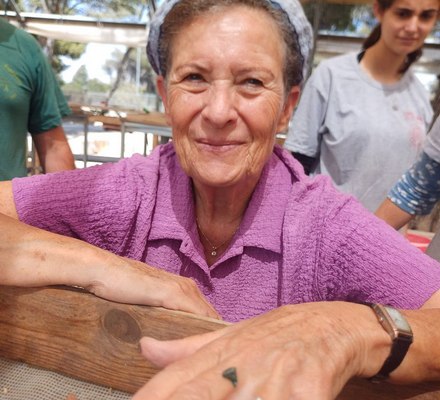
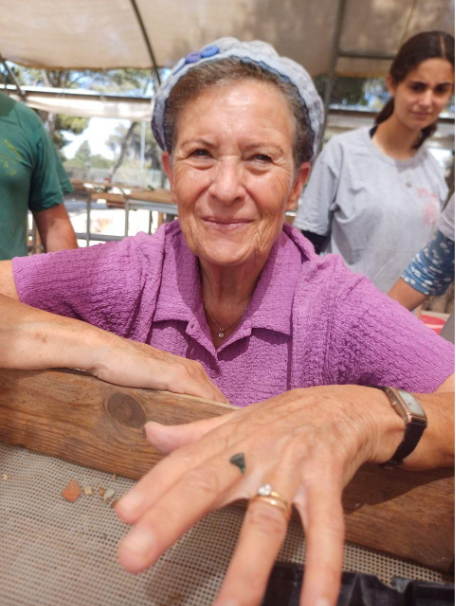
Irène Pollak-Rein, born in Zurich, Switzerland, has lived a life deeply intertwined with Jewish history and the city of Jerusalem. A madricha in Bnei Akiva during the Six-Day War, she made the decision to build her future in Israel, beginning with a formative year at Machon Gold and later earning a master’s degree in Jewish History from Hebrew University – while pregnant with her fifth child.
Her professional journey included nearly 34 years at the Jerusalem Foundation, where she served as desk head for German-speaking countries. Her historical expertise proved invaluable in fundraising efforts. In recognition of her dedication, she received the Worthy of Jerusalem (Yakirat Yerushalayim) award five years ago.
Irène, whose love for Jerusalem and its sacred heart – the Old City, the Kotel, and the Temple Mount – is profound, became acquainted with archaeologist Zachi Dvira. She and her husband Eli Pollak, a scientist at the Weizmann Institute, had previously met Prof. Gabi Barkay at the home of Stephen and Ruth Adler in the Old City.
In May 2025, upon retiring from the Jerusalem Foundation, Irène began volunteering at the Sifting Project one day a week. Trained alongside two Sherut Leumi volunteers from the USA, she finds the experience rejuvenating and deeply meaningful. She also generously donated suitable chairs so that pensioners like herself could sift in comfort while working for many hours.
Her passion for archaeology was sparked by her love of Jewish history and further inspired by her daughter, Tzilla Eshel, who pursued a career in archaeology at the University of Haifa. Now in retirement, Irène continues to explore new volunteer opportunities while cherishing time with her five children, 26 grandchildren, and two great-grandchildren – all living in Israel.
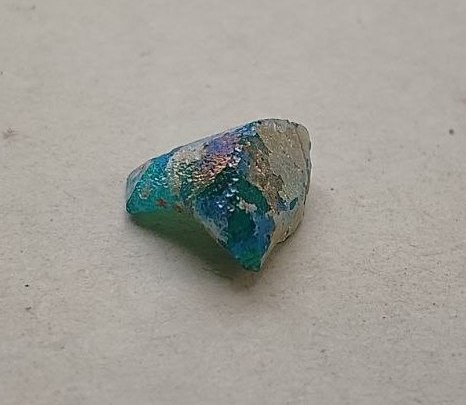
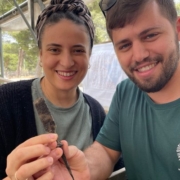
Irène found a very beautiful piece of glass jewelry. The fragment seems to have a curved profile, consistent with a ring formed with a simple band design. Its shimmering rainbow-like surface is called “patina” – the result of centuries of burial, during which the glass underwent chemical weathering. This process caused alkali to leach out and created microscopic layers that diffract light, producing the iridescent effect you see today. The colors – blue, green, purple, and pearly white – are typical of ancient glass that has been exposed to soil and moisture for long periods.
Glass rings were popular in the Roman and Byzantine periods, roughly between the 1st and 7th centuries CE. They were often made by winding molten glass around a rod or using a mold, then smoothing the surface. These rings served as affordable decorative items compared to precious metal jewelry and were widely worn by different social classes.
Finding such an artifact at the Temple Mount Sifting Project reflects the everyday life and craftsmanship of people who lived in Jerusalem during these eras. For Irène, sifting through the soil of the Temple Mount is not just an archaeological act, it is a spiritual privilege touching the very center of Jewish and world heritage.

Discover more from The Temple Mount Sifting Project
Subscribe to get the latest posts sent to your email.






Thank you, Irene, for your many years of work and support for the Temple Mount Sifting Project. What a wonderful way to spend your time and give back to the city you love!
As someone who has worked for a well-known museum here in the Washington, DC area, I know how important good volunteers can be!
I want to make a donation but can’t figure out how to do it on line.
Hi Fran, it is people like you that keep the project going. We are very grateful. The easiest way is through https://www.half-shekel.org/ God bless you