
Find and Finder of the Month: Yishai Lawi – A Family’s Dream & A Marble Mystery

Touching the Dream
As we approach the 29th of Cheshvan – falling this year on November 8-9 Israel prepares to celebrate Sigd. An official national holiday since 2008, yet celebrated since ancient times by the Ethiopian Jewish community, it is traditionally observed 50 days after Yom Kippur to honor their centuries-old dream of returning to Zion.
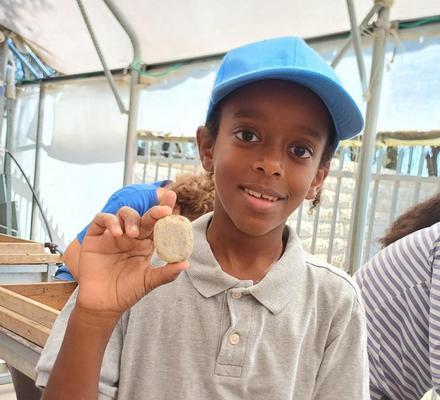
For one family, that distant dream recently took on a tangible reality in the soil of Jerusalem, coming full circle at the Temple Mount Sifting Project. While sifting through the very earth his ancestors longed for, Yishai Lawi — son of the first ordained traditional spiritual leader (Kess) of the Ethiopian Jewish community born in Israel —unearthed a mysteriously polished stone. Though this work connects us to Jerusalem’s spiritual past, uncovering everyday objects is what truly breathes life into these ancient remains.
Even without knowing exactly what it was, Yishai felt he had found something extraordinary. “I didn’t think I’d find anything,” he shared. But the moment he understood he had made a special discovery, his joy was palpable. “My heart truly leapt. I felt that it was incredibly ancient, and I felt a connection to the people of Israel and to the people of Israel’s history.” Through this object, Yishai’s connection to his people’s past and to the city was no longer abstract—he was holding it in his hand.
The Process of Identification:
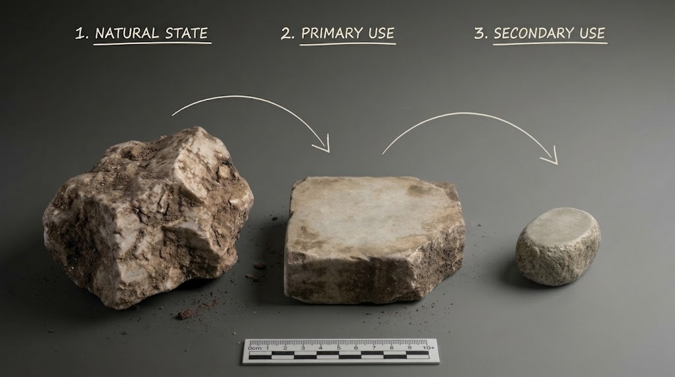
Initially, our archaeologists guessed the find was a limestone capstone for an ancient bow drill, a tool common during the Bronze and Iron Ages (biblical times). However, cleaning the artifact revealed a plot twist: it is made of marble. Because the Land of Israel lacks natural marble resources, this stone had to be imported – a practice that only began in earnest during the Late Roman period. As a result, the artifact must date to the Late Roman era or later.
When we examined the stone closely, the marks showed that its two smooth sides were polished with advanced tools, indicating it originally served as a wall tile. The Sifting Project has recovered thousands of such tiles, mostly dated to the Byzantine and Early Islamic periods, and similar marble tiles continue covering the walls of Islamic structures on the Temple Mount to this day.
At some point, a resourceful craftsman salvaged a broken chunk of this tile, roughly rounding its edges so it could fit comfortably in the palm of a hand.
So, What Is It?
Our first instinct was that it might be a handheld polishing stone (burnisher) or small grinder. However, a much more compelling proposal is that the stone functioned as an ad-hoc commercial weight. Unlike the many precise metal weights from the Byzantine and Islamic periods recovered by the Sifting Project—which were used for fine measurements of scarce metals and spices – this marble oval was likely an everyday market weight for bulk produce such as wheat and oil.
This proposal aligns nicely with the weight standards of the Early Islamic period. It is possible the stone was shaped to weigh 2 Egyptian uqiyyahs (approx. 35-37 grams each), which was a recognized weight standard in Jerusalem’s markets during this time.
Today, its weight stands at 72.04 grams. Despite signs of breakage and wear, its smart design still allowed it to remain stable and accurate on the balance scales: the flattened poles prevented it from rolling, and the polished sides helped prevent further damage. Furthermore, faint side scratches raise the tantalizing possibility that an official authorization symbol was once engraved on it.

Coming Full Circle
After being lost in the earth for centuries, the polished marble sphere, found its way into Yishai’s hands -an encounter taking on even deeper meaning in light of the upcoming Sigd holiday. This simple object, which most likely served as a makeshift market weight, offers a quiet glimpse into daily life in Jerusalem, set against the grand backdrop of the Temple Mount.
For generations, the Ethiopian Jewish community dreamed of the holy city of Jerusalem, turning their prayers toward it from afar. Through the sifting process, Yishai gained a direct, physical connection to the city and its past. For him, the simple act of touching earth and stones transformed into a deep bond with history and heritage. Just in time for Sigd, a distant, spiritual dream became a tangible reality in the soil of Jerusalem.
We want to hear from you!
If you were an ancient merchant using this 72-gram marble weight, what goods would you be measuring in the market? Drop your answers in the comments!
Want to uncover history yourself?
Book a Sifting Experience with us or Support Our Research.
Discover more from The Temple Mount Sifting Project
Subscribe to get the latest posts sent to your email.


Leave a Reply
Want to join the discussion?Feel free to contribute!